




Montgomery Introduces 2026 Budget. Focus on Reserves, Core Services, and Capital Needs
Nicholas Mistretta
MONTGOMERY, NJ — Montgomery Township officials on April 16 introduced a proposed 2026 municipal budget built around a familiar balancing act: holding the line on discretionary spending while absorbing higher costs for health insurance, police salaries, pensions, utilities, and capital needs. The presentation, delivered by Chief Financial Officer Michael Pitts, also included supporting remarks from Public Works Director Jeff Birkland.
Deputy Mayor Vince Barragan, speaking before Pitts began, described the budget as an attempt to reflect resident priorities while maintaining financial discipline. He said the governing body had heard clear public sentiment on several points: minimizing development, avoiding cannabis-related revenue, preserving emergency services, pursuing only shared services that create value for Montgomery, and taking a hard line on staffing growth. He also stressed that the municipal portion represents less than 15 percent of the total local property tax bill, with schools and county government accounting for the much larger shares.
Pitts, who said the budget process began in September and involved line-by-line reviews with department heads and the township’s Budget and Finance Committee, emphasized transparency throughout the presentation. He said the proposed budget is being introduced, not adopted, and that a public hearing and final action are scheduled for May 14, allowing time for public review and comment.

What the Budget Would Mean for Taxpayers
Under the proposal, the municipal tax rate would rise from $0.48 to roughly $0.50 per $100 of assessed value, which Pitts described as a 2.1-cent increase. On the township’s average assessed home value of $505,749, he said that would amount to an annual increase of $98.74, or about $8.23 per month, for municipal purposes. He also noted that the township’s ratables declined by $5.6 million and that the average assessed home value fell by $1,651, factors that affect how the final rate is calculated.
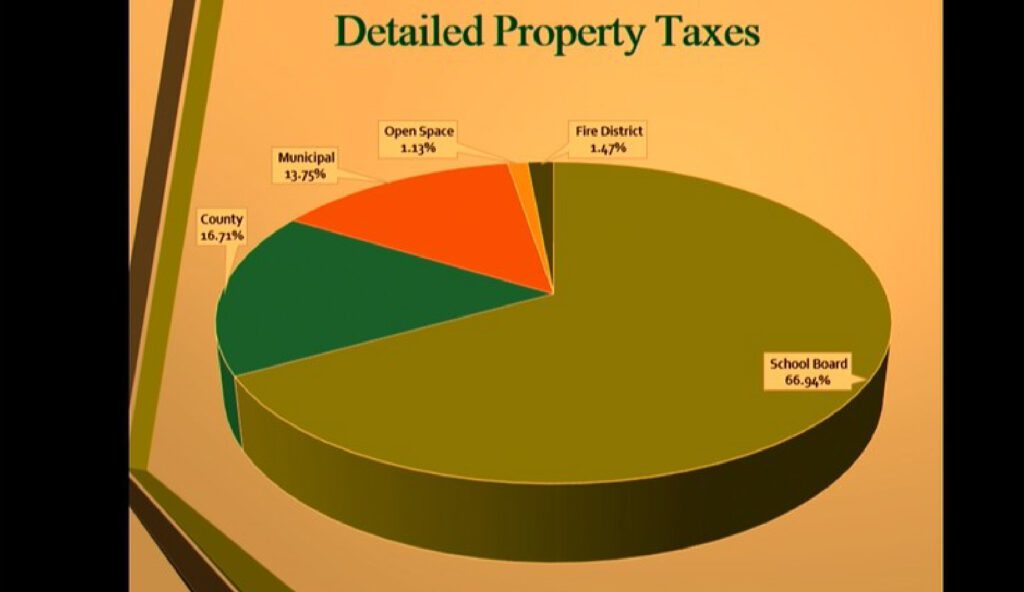
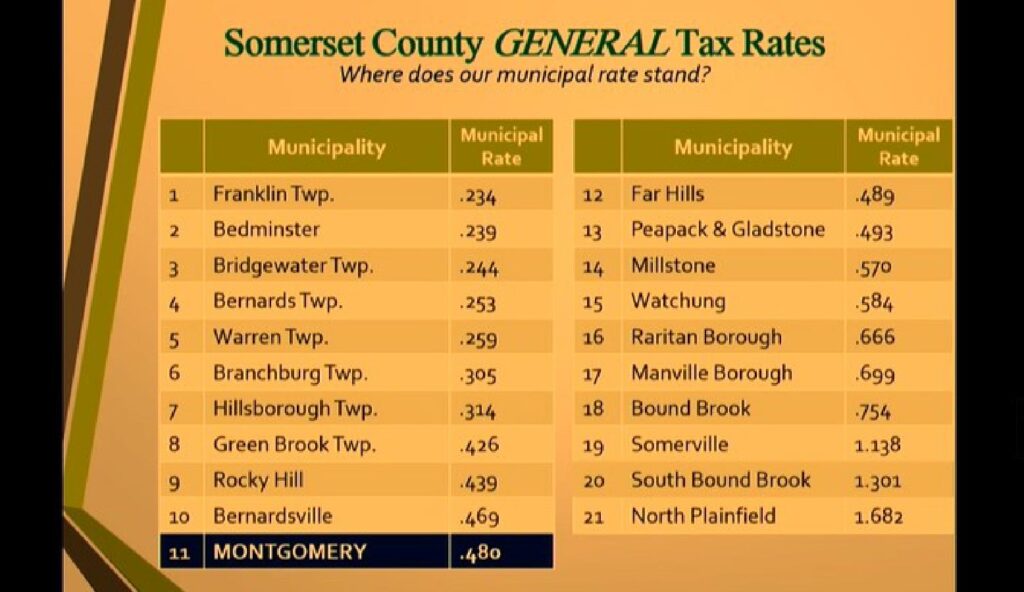
Pitts also addressed what he said were misconceptions about Montgomery’s tax position within Somerset County. According to figures he presented from the 2025 county abstract of ratables, Montgomery’s municipal tax rate is in the middle of the county pack, with ten municipalities above it and ten below it. He added that the municipal portion of the overall property tax bill represents a relatively small share of what residents pay. According to budget figures, the township accounts for approximately 13.75 percent of the total tax bill, Somerset County represents about 16.71 percent and the School Board accounts for 66.94 percent. Additional portions include the fire district at roughly 1.47 percent and open space at approximately 1.13 percent.
Officials noted that while the township collects the full property tax bill on behalf of all entities — including schools, the county, and the fire district — it retains only the municipal share, which is the portion subject to adjustment through the local budgeting process. They also indicated that residents will see this breakdown reflected on their tax bills, typically issued in late summer.
The Budget’s Main Drivers
Pitts described the 2026 proposal as a budget with very little flexibility on the spending side. He said just eight line items account for roughly $1.06 million of the $1.1 million overall increase: health insurance premiums are up $266,000; police salaries are up about $260,000; other salaries are up $145,000; capital improvements are up $143,000; other expenses are up about $100,000; utilities are up $79,000; and payroll taxes and pensions also increased. At the same time, he said, discretionary spending across departments was held flat, with no increase in “other expenses” and only one added position, funded through construction-code fee revenue rather than the general tax levy.



On the spending side, Pitts showed that salaries and wages remain the township’s largest single expense at about 33 percent of the budget, followed by debt service at 18 percent. He noted that police salaries have risen significantly faster than non-police salaries over the past six years, reflecting both contractual increases and personnel additions in a department the township has made clear it does not want to cut. Barragan said the township recently approved a police contract at 3.75 percent, below the 5 percent initially sought, describing that as part of the effort to balance public safety needs with taxpayer concerns.
Pitts also laid out what he called the township’s “core budget” — excluding grants, which pass through both the revenue and expense sides and can distort year-to-year comparisons. On that basis, he said the 2026 budget increases from $31.7 million to $32.8 million, a 3.49 percent rise. He and Barragan both argued that, even with that increase, the township’s spending growth remains below recent inflation trends.



A Budget Heavily Dependent on Property Taxes
Pitts repeatedly returned to what he said is a structural reality of Montgomery’s finances: the township is heavily reliant on property taxes because it has limited commercial ratables and relatively few alternative recurring revenue sources. He said 39 percent of the township — about 8,000 acres — is preserved open space, and that the town’s largely residential character, limited warehousing, lack of cannabis businesses, and emphasis on quality of life over commercial expansion all constrain revenue growth. He said commercial property represents only about 2.2 percent of the township’s tax base, one of the lowest shares in Somerset County.
For 2026, the amount to be raised by taxation is projected at about $20.27 million, up roughly $836,000 from the prior year. Pitts said that amount is what remains after accounting for all anticipated non-tax revenues. He also discussed a handful of smaller recurring revenue streams the township has been trying to build, including cell tower leases and shared services. Existing cell towers at the baseball fields generate about $200,000 annually, he said, while a new municipal tower is expected to bring in $41,000 annually initially, with additional revenue possible as more providers lease space. Shared services, he said, now generate more than $260,000 in revenue, though Barragan cautioned that those arrangements help at the margins and are not a “silver bullet” capable of solving larger structural challenges.




Concern Over Surplus Use
One of the most consequential parts of the presentation centered on surplus, the reserve fund the township has used in recent years to cushion tax increases. Pitts said the township used $5.3 million in surplus in the prior year budget — the most in more than a decade — but regenerated only a small fraction of that amount. For 2026, the township is proposing to reduce the use of surplus to $5.1 million, which would leave an ending balance of about $3.7 million, the lowest since 2019.
Both Pitts and Barragan described that trend as unsustainable. Pitts said that if the township were to keep using surplus at the recent pace without replenishing it, it could deplete the reserve within a few years, risk losing its AAA bond rating, and potentially create fiscal distress. Barragan said the easier short-term move would have been to use more surplus and lower the tax increase, but he argued that doing so would only defer and worsen the problem. Instead, the township is trying to start reducing its dependence on surplus now, even though that means a somewhat higher immediate tax impact.
Pitts said the township views a surplus level around $4.6 million to $4.7 million as a healthier long-term target. He explained that surplus is regenerated when actual revenues come in above budget or actual expenses come in below budget, but said rising costs have increasingly eaten away at the cushion that once helped replenish the fund.

Public Works Capital Requests: Trailer, Dump Truck, and Roads
As part of the capital discussion, Pitts said the proposed 2026 capital program increases engineering’s road-related allocation to about $1.9 million, up from roughly $1.4 million the prior year, because the township is trying to pay more attention to road conditions. Even so, he said the amount falls well below what engineering requested. He added that the Department of Public Works would also receive capital funding for a trailer, a dump truck, and $500,000 for in-house paving work.
Birkland used his portion of the presentation to explain the DPW trailer request, focusing on current working conditions. He said the existing trailer at the public works yard functions as a locker room and that the original municipal building at the site is being used as a break room and lunch area, with two bathrooms inside. He described the current situation as one that “definitely needs to happen soon” in terms of improvement, and said the proposed trailer would include bathrooms, locker room space, and a lunch area. He added that the township is still pursuing grants to refurbish and upgrade the original municipal building.

Photo Credit: Nicholas Mistretta/headlinenewsmontgomery.com