



Forged in Clay, Cast in Legacy: Montgomery Sculptor Tim Maslyn’s Lasting Imprint: A Life in Bronze, Built on Craft, Character and Quiet Mastery
Nicholas Mistretta
Timothy A. Maslyn did not simply make sculpture. He built it — methodically, reverently, and with the steady discipline of someone who understood that mastery begins with knowing your tools.
Born March 8, 1957, in Red Bank and raised in Hillsborough, Maslyn’s earliest training came not in an art school studio but beside his father, a skilled woodcarver. There, as a young teenager, he learned how each tool functioned, how wood grain responded to pressure, and how patience shaped outcome. Those lessons would become foundational when he later turned to clay.
After high school, Maslyn enrolled at duCret School of Art in Plainfield, hoping to pursue sculpture formally. When he discovered sculpture classes were unavailable, he chose not to continue. Instead, he worked a range of jobs — lawn maintenance, factory shifts, even at a clay supply company — while seeking a serious entry point into the field.

That opportunity arrived in 1977 when he was introduced to retired Princeton University sculptor Joseph Brown.
Maslyn later described his first visit to Brown’s studio as overwhelming. Sculptures filled the space in every size and stage of completion, many athletic figures rendered with fluid strength. Brown, already nearing the end of a distinguished academic career, did not offer formal instruction at first. He offered something more revealing: the chance to observe, assist, and prove usefulness.
Maslyn swept floors, cut grass, maintained tools. He watched closely as Brown modeled clay and constructed molds. Gradually, Brown tested him — asking him to copy a piece, to demonstrate whether he truly understood form.
He did.
Within a few years, Maslyn became Brown’s assistant, working directly on modeling, mold-making, bronze chasing, and finishing. He learned the entire lost-wax casting process — from clay composition to rubber molds, wax casting, ceramic shell formation, bronze pour, and final patination.



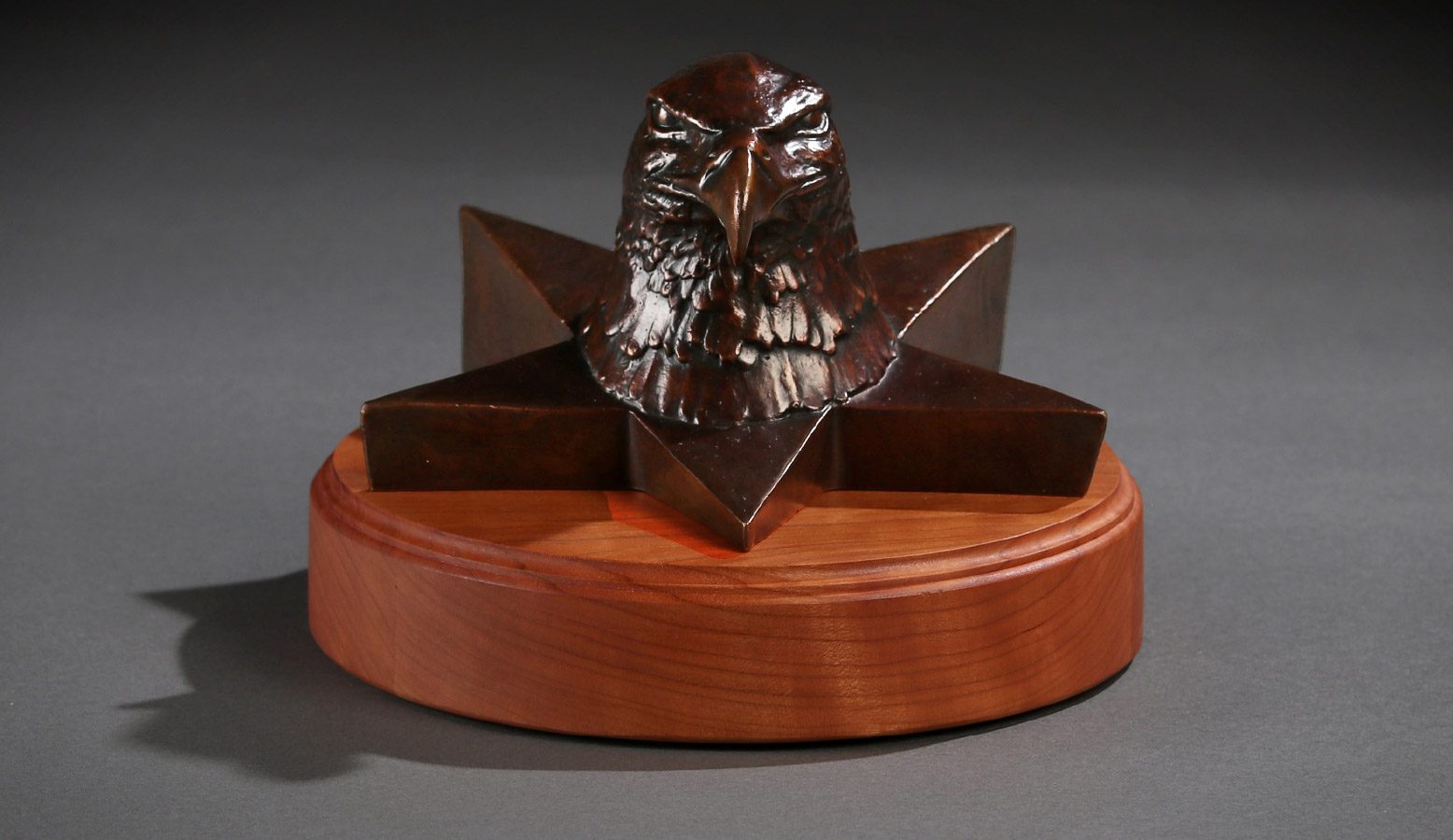
One of Maslyn’s earliest independent works during this period was “The Eagle” an eagle perched on a five-point star — conceived as a tribute to family members who served in the military. Brown critiqued the expression of the bird, adjusting the lip to better capture its character. The modeling was sound, Brown affirmed. The correction sharpened it.
That eagle became symbolic in more ways than one. It represented the moment Maslyn moved from student to sculptor.
When Brown died in 1985, Maslyn was designated Director and Curator of the Joe Brown Studio, overseeing and preserving a collection of more than 300 works. The responsibility was significant. He cataloged, maintained, and continued producing works faithful to Brown’s artistic standards.
In 1993, he and his wife, Janine, established Maslyn Studios, specializing in original bronze portrait and figurative sculpture. Over the next 15 years, Maslyn created public commissions, Ivy League championship trophies, memorial sculptures, and portrait busts known for their accuracy and presence.
Among his notable works were a sculpture of General Robert R. Neyland for the Knoxville Quarterback Club, the life-size figure at the New Jersey Firemen’s Home in Boonton, and numerous Ivy League athletic awards still presented annually.



He also taught with ARTWORKS in Trenton and demonstrated sculpting for local schools, sharing the process generously with others.
Those who visited Maslyn’s studio remember not only the craftsmanship, but the man: kind, humorous, patient, and willing to explain the technical complexities of bronze casting in plain language. Conversations often became stories; lessons became laughter.
Maslyn died in November 2008 at age 51.
Today, his legacy is preserved through Maslyn Studios under the stewardship of Janine Maslyn. As the nation approaches the 250th anniversary of American independence in 2026, the studio is making Maslyn’s early The Eagle available to the public in bronze casting — a fitting release for a moment of national reflection.
The eagle, refined under the eye of a master and born from personal tribute, stands not only as a patriotic symbol but as evidence of a life shaped by discipline, mentorship, and belief in craft.
Timothy A. Maslyn understood that sculpture is more than ornament. It is memory made durable. It is conviction cast in metal.
And nearly two decades after his passing, his work remains — grounded, deliberate, and enduring.

Janine Maslyn and the Work of Preservation
Today, as the country approaches the 250th anniversary of America’s founding, Maslyn’s legacy finds renewed resonance in one of his earliest and most personal works — The Eagle.
Originally conceived as a tribute to members of his own family who served in the armed forces, the sculpture marked a turning point in Maslyn’s apprenticeship under Joseph Brown. It was the piece that earned Brown’s serious critique and affirmation. It was the moment Maslyn understood not only that he had talent — but that he had direction.
The eagle’s expression, refined under Brown’s watchful eye, symbolized strength shaped by discipline. It was American in spirit, but deeply personal in origin.
In conjunction with the nation’s Semiquincentennial celebration, Maslyn Studios is now making The Eagle available for purchase, offering collectors and patrons an opportunity to own a work that embodies both Maslyn’s artistic beginnings and the enduring symbolism of American resolve.

For Janine Maslyn, preserving and presenting her husband’s work is not simply about remembrance — it is about continuity.
Timothy A. Maslyn believed sculpture should live where people live — in homes, in institutions, in public spaces where it can be seen, touched, and reflected upon. He believed art should not sit quietly in obscurity.
Nearly two decades after his passing, his bronzes still speak — of discipline learned in a father’s workshop, of mentorship earned in a Princeton studio, of craftsmanship practiced without compromise.
And now, as America marks 250 years, one of his first sculptural statements takes its place once again — not only as a symbol of a nation, but as a testament to the life of the man who shaped it in clay.
For more information or to purchase “The Eagle” click here.
Photo Credit: Nicholas Mistretta/headlinenewsmontgomery.com