






Montgomery’s Deer Management Program Highlighted at August 21st Township Committee Meeting
Nicholas Mistretta
At its August 21st regular meeting, the Montgomery Township Committee heard an in-depth presentation on the township’s Deer Management Program from Open Space Stewardship Director Lauren Wasilauski and Wildlife Committee Chair Jamie McQuaid.



The program, now widely regarded as a model across the state, is designed around three main priorities: public health—by addressing the spread of tick-borne diseases; public safety—by reducing deer-related vehicle collisions; and forest ecology—by preventing damage caused when deer strip bark from young trees or consume vegetation critical to the next generation of forest growth.
Montgomery’s Wildlife Committee, originally established in 1992 as the Hunting Committee, makes annual recommendations to the Township Committee on managing the deer population. The program allows hunting on select township-owned properties in order to keep deer numbers in check.
McQuaid noted one ongoing challenge: the need to recruit new hunters as the current group ages. Youth permits are available, and Deputy Mayor Vincent Barragan and Mayor Neena Singh suggested creating a mentoring program for those interested in learning but without family members to pass along traditional skills.
Strict safeguards are built into the program. Hunters must show proof of $1 million in liability insurance, pass a background check, attend annual training, and notify the township before heading out. Hunting is limited to tree stands, ensuring shots are fired safely downward. “To date, there have been zero incidents or accidents associated with the program,” officials reported.
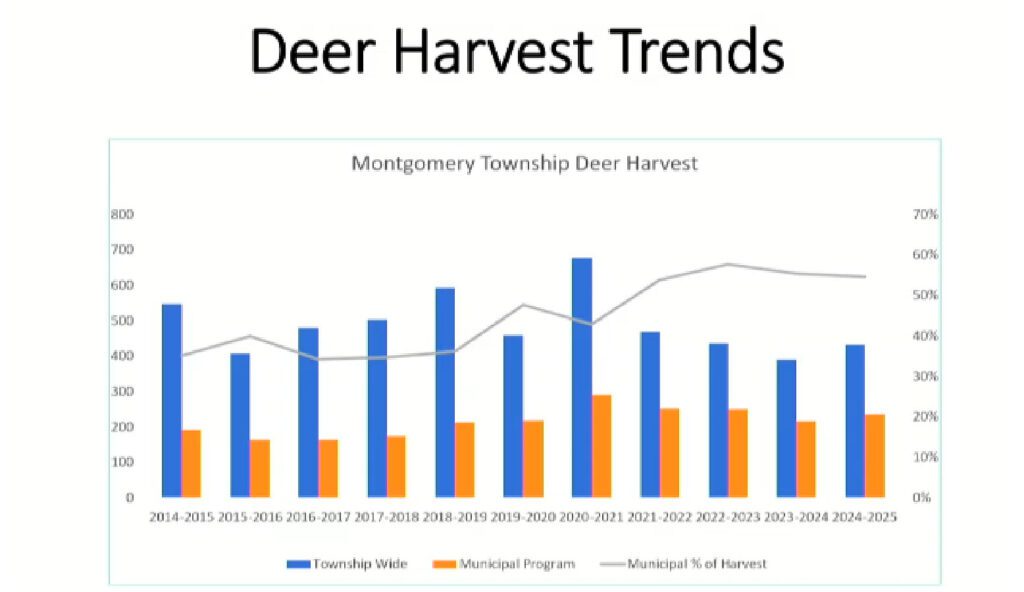
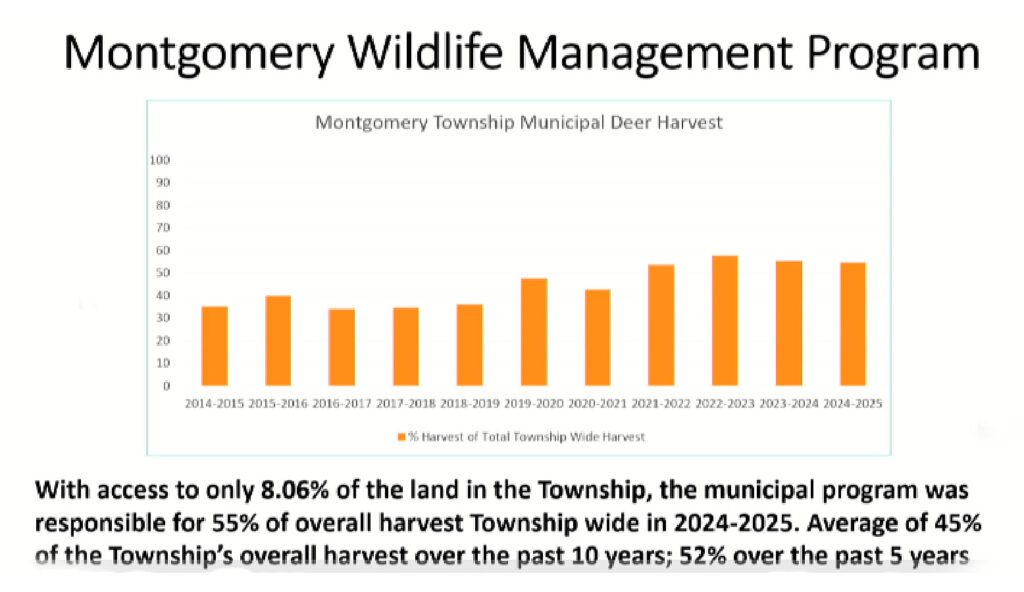
Despite being conducted on only 8.06% of township land, the program accounts for 55% of the total deer harvest in Montgomery. One of its biggest benefits, is the partnership with Hunters Helping the Hungry, a nonprofit that donates venison to food banks. Statewide in 2024–25, the initiative provided over 40,000 pounds of venison, creating more than 161,000 meals. Locally, Montgomery’s hunters donated 82 deer, yielding 2,567 pounds of venison and over 10,000 servings for families in need.
Looking ahead, the program will continue to evolve. Plans include moving to digital registration for longtime participants, electronic harvest reporting, and streamlined end-of-year surveys. Demand remains strong, with a waiting list of about 15 individuals. “It’s a popular program. It’s a recommended program,” McQuaid noted.
Mayor Singh closed the presentation with thanks to Wasilauski, McQuaid, and Township Clerk Lisa Fania, acknowledging the importance of transparency. “When I first joined the committee four years ago, my only concern was safety—especially for new residents who may not expect hunting near neighborhoods,” Singh said. “Presentations like this are invaluable for showing the clear benefits and safeguards of a program that is truly an asset to Montgomery.”
Photo Credit: Nicholas Mistretta/headlinenewsmontgomery.com